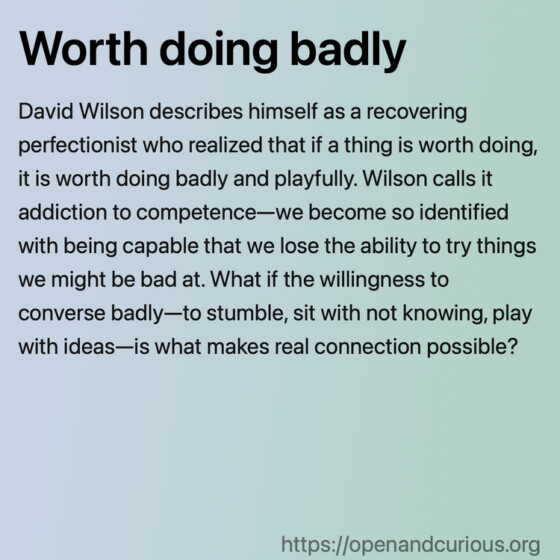
David Wilson describes himself as a “recovering perfectionist”—someone who spent years picking up activities for a week or a month before the romance wore off, largely because he felt that if he couldn’t do something well, it wasn’t worth doing at all. Then something shifted.
If I can be more compassionate toward myself, I can let go of this addiction to competence and just let myself try, and suck. So yeah, I have come to embrace the idea that if a thing is worth doing, it is worth doing badly and playfully.
There’s a familiar inversion lurking in that phrase. The original saying—”if a thing is worth doing, it is worth doing well”—has been weaponized into a perfectionist’s creed: don’t attempt what you can’t excel at. Wilson flips it entirely. Worth doing badly. Worth doing playfully. Not as a consolation prize, but as the actual point.
What happens when we apply this to conversation?
If these field notes spark your thinking, you'd like Open + Curious Field Guides — essays that trace one idea across several conversations to discover the bigger picture.
https://openandcurious.org/field-guides/
Most of us carry an unexamined assumption that good dialogue requires a certain level of competence. We should know what we’re talking about. We should articulate clearly. We should ask intelligent questions, offer useful insights, avoid awkward pauses. We’ve absorbed a standard of conversational performance that makes us hesitate before speaking—or avoid certain conversations altogether.
Wilson names this pattern: addiction to competence. Once we graduate into adult responsibilities, we become so identified with being capable that we lose the ability to try things we might be bad at. Our identities get wrapped up in expertise. We forget how to be beginners.
But genuine dialogue often requires exactly what competence addiction prevents: the willingness to stumble, to not know, to ask the question that reveals our ignorance. The most connecting moments in conversation frequently happen when someone admits confusion, when the polished surface cracks and something authentic shows through. Perfectionism, it turns out, is a form of hiding.
Wilson links playfulness directly to compassion—they assist each other, he says. When we can take ourselves less seriously, we can engage with things “not because we expect to be good at them, but because we actually might enjoy them.” This opens up territory that competence addiction keeps locked away: conversations we’ve been avoiding because we don’t feel qualified, questions we haven’t asked because we might sound foolish, connections we haven’t made because we’re waiting until we have something impressive to offer.
What if the demand for conversational competence is precisely what keeps us from genuine dialogue? What if the willingness to converse badly—to stumble through an unfamiliar topic, to sit with not knowing, to play with ideas rather than perform expertise—is what makes real connection possible?
Wilson’s reframe isn’t about lowering standards. It’s about recognizing that the standard itself might be the obstacle. The thing worth doing badly might be worth doing badly because that’s the only way we’ll ever do it at all.
This field note references the Movers Mindset episode “Curiosity with David Wilson,” published May 19, 2025.
This work was produced using AI language models directed through an editorial system designed by Craig Constantine. The author selected all source material, designed the creative framework, directed the editorial process, and made all acceptance and revision decisions. The prose was generated by AI under sustained human editorial direction.
This is a companion discussion topic for the original entry at https://openandcurious.org/2025/12/20/worth-doing-badly/